How Regenerative Braking Works in Electric Vehicles
Regenerative braking is one of the most important and innovative technologies used in electric vehicles. Unlike traditional braking systems that waste energy as heat, regenerative braking helps recover energy while slowing down the vehicle. This recovered energy is then sent back to the battery, improving overall efficiency and driving range.
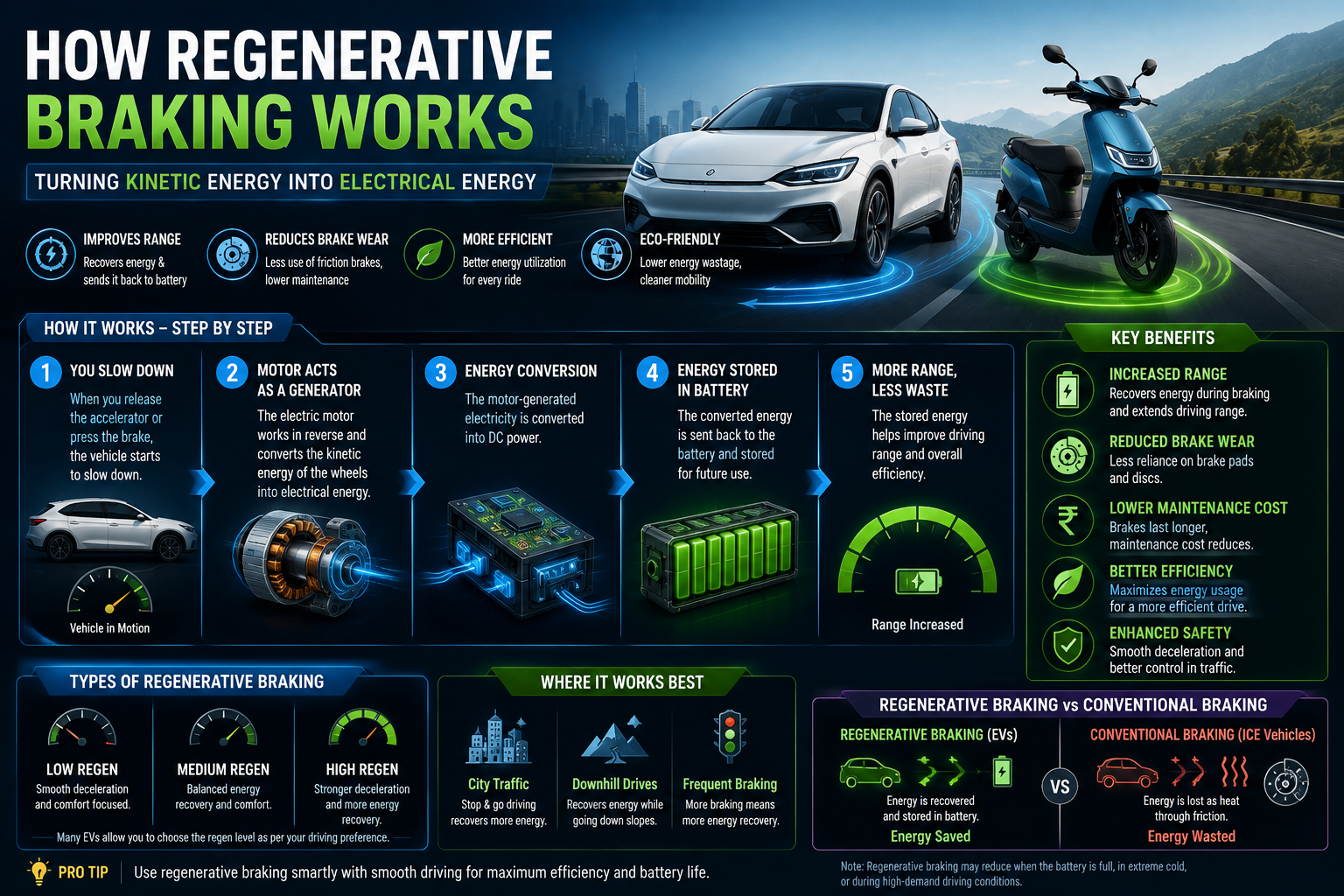
In conventional petrol or diesel vehicles, braking converts kinetic energy into heat through friction between brake pads and brake discs. This energy is completely wasted. However, electric vehicles use regenerative braking to convert part of that kinetic energy back into electrical energy.
The working principle of regenerative braking is based on the electric motor. In an EV, the motor usually works in two modes. During acceleration, it uses electrical energy from the battery to rotate the wheels. During regenerative braking, the same motor works in reverse as a generator.
When the rider or driver reduces acceleration or presses the brake pedal, the motor starts slowing down the wheels. At the same time, the rotating wheels force the motor to generate electricity. This generated electricity is sent back to the battery pack for storage.
This process helps improve energy efficiency and slightly increases the driving range of the vehicle. In city traffic conditions where frequent braking occurs, regenerative braking can significantly improve overall efficiency.
Different EVs provide different levels of regenerative braking strength. Some electric scooters and cars offer mild regenerative braking, while others provide aggressive regenerative braking that slows the vehicle quickly when the accelerator is released.
Many modern EVs also allow users to adjust regenerative braking levels through software settings. Higher regenerative braking can improve energy recovery, but some drivers may prefer smoother driving with lower regenerative intensity.
One major advantage of regenerative braking is reduced brake wear. Since the electric motor handles part of the braking process, traditional brake pads and discs experience less friction usage. This helps reduce maintenance costs and extends brake component lifespan.
Regenerative braking also improves driving efficiency in hilly areas. While descending slopes, EVs can recover energy continuously and recharge the battery partially during downhill driving.
However, regenerative braking also has limitations. It may not fully stop the vehicle during emergency braking situations. Therefore, traditional friction brakes are still necessary for safety and complete stopping power.
Battery condition and charging level can also affect regenerative braking performance. If the battery is already fully charged, the vehicle may reduce regenerative braking capability because there is limited space available to store recovered energy.
Weather conditions can influence regenerative braking too. In slippery road conditions, the vehicle’s software carefully manages braking force to maintain stability and traction.
Regenerative braking is especially useful for urban commuting because stop-and-go traffic creates more opportunities for energy recovery. This is one reason why electric vehicles often achieve excellent efficiency in city driving conditions.
Many advanced EVs now combine regenerative braking with intelligent driving systems. Some vehicles automatically optimize regeneration based on traffic conditions, navigation data, and driving behavior.
As EV technology continues to improve, regenerative braking systems are becoming more advanced and efficient. Future electric vehicles may achieve even greater energy recovery rates through improved motor and battery technologies.
In conclusion, regenerative braking is a smart energy-saving technology that improves EV efficiency, increases driving range, reduces brake wear, and enhances overall sustainability. It is one of the key features that makes electric vehicles fundamentally different and more efficient than traditional petrol and diesel vehicles.