What Are the Different Types of EV Chargers Available for Electric Vehicles in India?
As electric vehicles become more popular in India, EV charging infrastructure is also expanding rapidly. Different types of EV chargers are available based on charging speed, vehicle compatibility, and Indian government standards. Understanding these chargers is important for EV owners, businesses, and fleet operators.
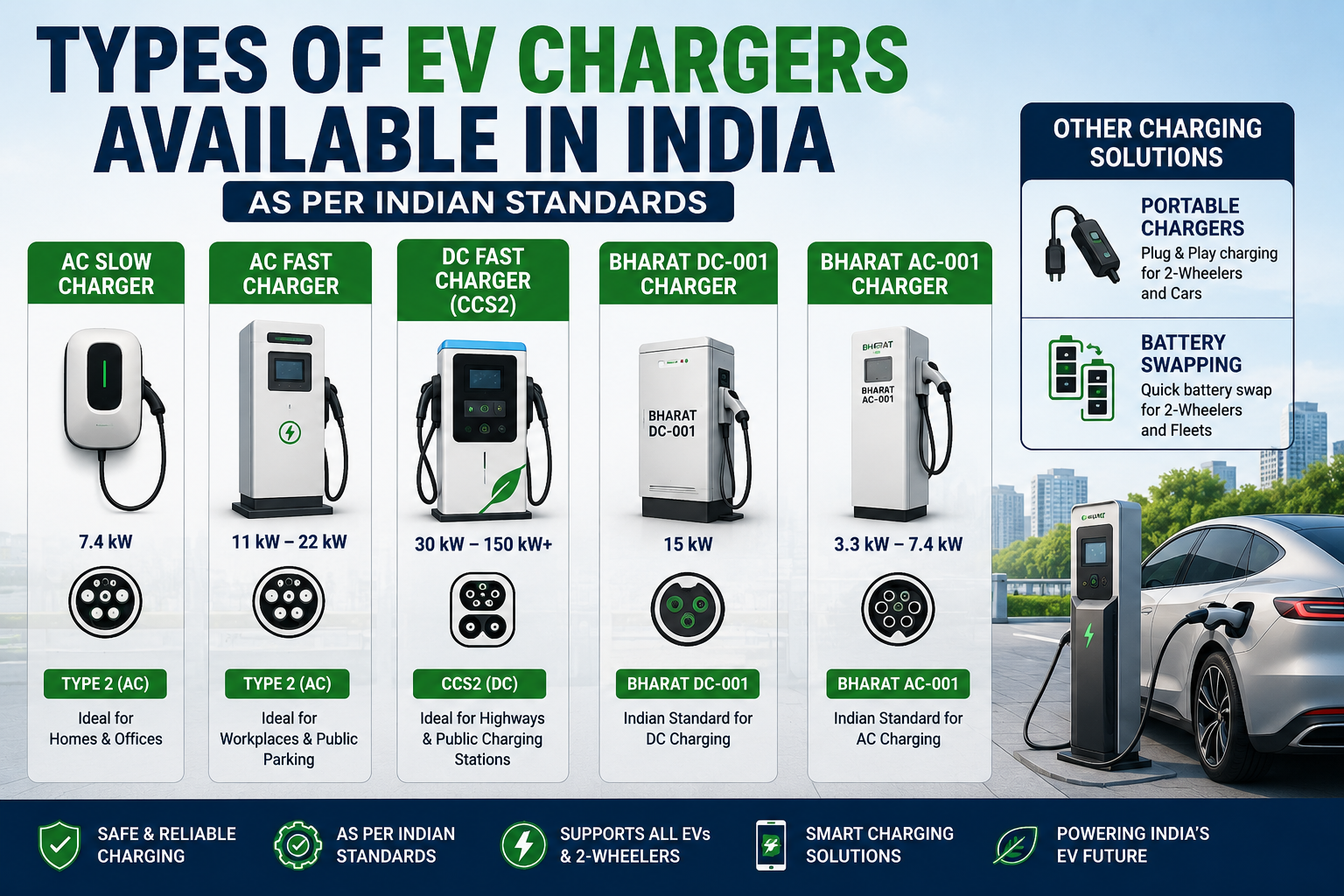
EV chargers in India are mainly divided into AC chargers and DC fast chargers. AC chargers are commonly used for home charging and slow charging applications, while DC chargers are mainly used for public fast charging stations and commercial purposes.
The most common type is the AC slow charger. These chargers are usually installed in homes, apartments, and offices. Most electric scooters and many electric cars support AC charging. AC chargers convert alternating current into direct current through the vehicle’s onboard charger. Charging speed depends on the charger capacity and vehicle compatibility. Typical home chargers in India range from 3.3 kW to 7.4 kW. These chargers are affordable, easy to install, and ideal for overnight charging.
Another important charger category is the AC fast charger. These chargers provide higher charging speeds compared to standard home chargers. They are mostly used in commercial parking spaces, malls, and workplaces. AC fast chargers are becoming more popular because many modern EVs support higher AC charging capacities.
India also uses DC fast chargers for rapid charging applications. DC chargers directly supply power to the battery, bypassing the onboard charger. This allows significantly faster charging speeds. DC fast chargers are commonly found on highways, public charging stations, and fleet charging hubs. Charging capacities can range from 15 kW to over 150 kW depending on the charger type.
As per Indian standards, Bharat DC-001 chargers were introduced mainly for electric cars. These chargers support lower-voltage DC charging and are commonly seen in early Indian EV infrastructure. Bharat AC-001 chargers are another Indian standard mainly designed for slow AC charging. These chargers can charge multiple vehicles simultaneously at moderate power levels.
However, global charging standards are also becoming popular in India. CCS2, also known as Combined Charging System Type 2, is currently one of the most widely used DC fast charging standards for electric cars in India. Many modern EV manufacturers support CCS2 charging because of its fast charging capability and international compatibility.
CHAdeMO chargers are another DC charging standard originally developed in Japan. Some older electric cars support CHAdeMO charging, although CCS2 is becoming more dominant in India.
Type 2 AC connectors are commonly used for AC charging in modern electric cars. These connectors support single-phase and three-phase charging and are widely accepted across global EV markets.
For electric two-wheelers, portable chargers are extremely common. Most electric scooters in India come with portable chargers that can be plugged directly into normal household sockets. Some premium electric scooters also support fast charging options through dedicated charging connectors.
Battery swapping is another emerging charging solution in India. Instead of charging the battery inside the vehicle, users can swap depleted batteries with fully charged ones at battery swap stations. This model is especially popular for commercial electric scooters, delivery fleets, and auto-rickshaws.
Smart charging technology is also improving rapidly. Many modern chargers now support mobile apps, remote monitoring, RFID access, scheduled charging, payment integration, and energy management systems. These features help improve convenience and charging efficiency.
The Indian government is actively supporting charging infrastructure growth through various policies and incentives. Public charging networks are expanding across highways, cities, malls, and commercial spaces to encourage faster EV adoption.
In conclusion, India’s EV charging ecosystem includes AC slow chargers, AC fast chargers, DC fast chargers, Bharat standards, CCS2 chargers, portable chargers, and battery swapping solutions. As EV adoption increases, charging technology and infrastructure will continue to evolve rapidly across the country.